Saturday, January 10, 2009

Workplace Bullies Are Bullies Outside Work, Too

Yesterday's Arizona Republic included two wire service fillers about mean, nasty behaviors toward one's neighbors. The first told of a 37-year-old man who tore open his neighbor's door with a chain saw. It seems that Robert Kane was upset because his neighbor's friend had parked in front of Kane's house.

The second story reported a man who had been sprinkling the driveways of neighbors he doesn't like with roof nails to cause flat tires. A policeman staking out a victim's home caught the perpetrator in the act of scattering nails. He was charged with harassment,  criminal tampering,  and mischief.

More than likely, these men are employed somewhere. How would you like be in the same workspace with either of them?

Workplace bullies are bullies before they darken the workplace door.

Saturday, January 3, 2009

Organizational Change: A Hotbed for Bullying

What's going on in the organization where you work? Are major changes taking place? Organizational changes are widely associated  with bullying behaviors, and it makes sense.

Global competitiveness, downsizing, restructuring, intensified workloads, technological change,  mergers, and acquisitions create STRESS. Many researchers believe these organizational changes  are risk factors for bullying. Frankly,  I doubt employees need researchers to reveal this fact: Almost forty percent of employees are living it.

Stress within organizations is no exception to the rule that for every action, there's a reaction. One  chain reaction that occurs looks like this:

Greater Job Insecurity  >  Increased Stress  >  More Authoritarian Management Practices  >  Inappropriately Coercive Managerial Behaviors  >  Employees Less Likely to Challenge Aggressive Treatment  >  The Bullying Continues

This is an example of environmental factors, such as the depressed economy, interacting with organizational factors to contribute to workplace bullying. In the current economical environment,  I anticipate that bullying, which is already a worldwide epidemic, will continue to increase, and I strongly urge targeted employees to take defensive action to protect your careers and your health. I also urge supervisors and managers to evaluate how stress is affecting your behavior. 

As employees or employers, you can't afford workplace bullying.

Wednesday, December 17, 2008

Fireman Bullied at Tucson Fire Department

Last Spring, a Tucson firefighter began litigation proceedings against the Tucson Fire Department for their bullying activities against him. Adam Neal accused his co-workers of harassment that included “tying him up with duct tape,” according to an Associated Press article in the Arizona Republic.

Neal stated he endured daily abuse that his supervisors at the Fire Department said was “just part of the training.” Eventually, due to the stress induced by these workplace bullies, Neal required four days of inpatient therapy for depression.

As often happens, the claim was settled out of court. In this case, the settlement was $60,000 but, of course, the Tucson Fire Department had no comment.

From a bottom-line perspective, this case cost much more than $60,000. One of the additional costs includes the time wasted on non-productive activities:
-time devoted to bullying
-time lost due to low employee engagement of the bullies and their target
-time spent on preparing and defending the case
-absenteeism
That’s only the beginning.

The next time an organization calls you requesting a contribution, you might want to think about it twice before donating your hard-earned dollars. Do a little research first to learn whether the organization in question has wasted its funds on bullying and other forms of harassment. Somebody has to pay the costs of bullying. But I don’t want to. And you probably don’t either.

Monday, December 8, 2008

Workplace Bullies in Training

Obsessive anti-social and paranoid behaviors are rampant among today’s young people. These disorders are not mere quirks, but are serious enough that they interfere with ordinary functioning. So reports Dr. Mark Olufson of Columbia University and New York State Psychiatric Institute.

Dr. Olufson and co-authors published a study this month in the Archives of General Psychiatry, which found that if drug and alcohol abuse are included, one-half of more than 5,000 young people (19 – 25) surveyed have some type of psychiatric condition. Second only to drug and alcohol abuse, personality disorders were the single largest category.

The statistics are frightening when we consider that at least 25 percent of these young adults will not receive treatment, yet most of them will likely be in workplace environments, if they aren’t already. Is it any wonder that workplace bullying is a worldwide epidemic and is on the increase?

Antisocial and paranoid behaviors are two descriptors frequently associated with workplace bullies. It seems that future workplace bullies are in training on college campuses and elsewhere right now.

Thursday, November 20, 2008

Are Workplace Bullies Animal Abusers?

Will current attention and discussion on workplace bullies expose animal abusers? Think about it.

Workplace bullies are likely to have been schoolyard bullies. As very young children schoolyard bullies were probably cruel to animals. This is well researched and documented.

The path leading from small children who pull wings off butterflies to bullies in the workplace is logical, and why would we believe that a person who undermines and terrifies a fellow employee wouldn’t continue to abuse animals, especially convenient household pets? Or even worse, sponsor or breed dogs for pit fights? The thought sickens me.

More on this later.

Tuesday, November 11, 2008

What Makes Bullies’ Brains Brighten?

Is it possible bullies can’t help being bullies? According to a recent study from the University of Chicago, behaving like a bully gives bullies pleasure.

Dr. Benjamin Lahey, a psychologist and co-author of the study had expected that bullies would be indifferent to the pain of others. Contrary to expectations, Dr. Lahey found that when 16- to 18-year-old boys observed videos depicting painful situations, both accidental and intentional, they registered brain activity in pleasure-related and pain-related areas. Additionally, their brain scans showed NO activity in the portion of the brain that helps regulate self-control.

Not only do bullies experience pleasure from seeing people in pain, but they are likely to respond to perceived “threats” or “insults” with knee-jerk, out-of-control behaviors—a dangerous combination that is positively reinforced every time they bully somebody.

What can be done? Dr. Lahey looks to the development of therapies to either treat or compensate for bullies’ lack of self-regulation.

For further work with students and communities regarding school bullying, visit the Olweus Bully Prevention Program site. This program began in Bergen, Norway, with the research of Dan Olweus, Ph.D., and is jointly supported in the United States by Hazelden (Minnesota) and Clemson University, where many people have been trained in the Olweus system and are now dispersed across the nation.

Thank you to Jackie Dishner, The Bike Lady, for drawing my attention to this study.

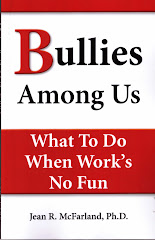
Jean R. McFarland, Ph.D. Author of Bullies Among Us, What To Do When Work's No Fun

Saturday, October 4, 2008

Kitty's "I'm In Charge of Me" Mindset

Negative behaviors at work disrupt performance and tend to lower employee morale, often causing employees to feel they have no control over their situations. I suggest that if employees deal with negative behaviors at the onset, they more likely than not can maintain an “I’m in charge of me” mindset. One of my colleagues, Kitty Wiemelt, wrote these words in her October 01, 2008, blog. Please visit her at Balancing the Winds of Change. I believe you will be inspired.

Also welcome two more NSA colleagues:

June Liggins
www.centerofdistinction.wordpress.com

Bonnie Mattick
www.YourBusinessDetective.com


Jean R. McFarland, Ph.D.
www.BadAppleSolutions
www.FifthDimensionStrategies.com
Author of Bullies Among Us. What To Do When Work's No Fun