Obsessive anti-social and paranoid behaviors are rampant among today’s young people. These disorders are not mere quirks, but are serious enough that they interfere with ordinary functioning. So reports Dr. Mark Olufson of Columbia University and New York State Psychiatric Institute.
Dr. Olufson and co-authors published a study this month in the Archives of General Psychiatry, which found that if drug and alcohol abuse are included, one-half of more than 5,000 young people (19 – 25) surveyed have some type of psychiatric condition. Second only to drug and alcohol abuse, personality disorders were the single largest category.
The statistics are frightening when we consider that at least 25 percent of these young adults will not receive treatment, yet most of them will likely be in workplace environments, if they aren’t already. Is it any wonder that workplace bullying is a worldwide epidemic and is on the increase?
Antisocial and paranoid behaviors are two descriptors frequently associated with workplace bullies. It seems that future workplace bullies are in training on college campuses and elsewhere right now.
Monday, December 8, 2008

Thursday, November 20, 2008
Are Workplace Bullies Animal Abusers?
Will current attention and discussion on workplace bullies expose animal abusers? Think about it.
Workplace bullies are likely to have been schoolyard bullies. As very young children schoolyard bullies were probably cruel to animals. This is well researched and documented.
The path leading from small children who pull wings off butterflies to bullies in the workplace is logical, and why would we believe that a person who undermines and terrifies a fellow employee wouldn’t continue to abuse animals, especially convenient household pets? Or even worse, sponsor or breed dogs for pit fights? The thought sickens me.
More on this later.
Workplace bullies are likely to have been schoolyard bullies. As very young children schoolyard bullies were probably cruel to animals. This is well researched and documented.
The path leading from small children who pull wings off butterflies to bullies in the workplace is logical, and why would we believe that a person who undermines and terrifies a fellow employee wouldn’t continue to abuse animals, especially convenient household pets? Or even worse, sponsor or breed dogs for pit fights? The thought sickens me.
Tuesday, November 11, 2008
What Makes Bullies’ Brains Brighten?
Is it possible bullies can’t help being bullies? According to a recent study from the University of Chicago, behaving like a bully gives bullies pleasure.
Dr. Benjamin Lahey, a psychologist and co-author of the study had expected that bullies would be indifferent to the pain of others. Contrary to expectations, Dr. Lahey found that when 16- to 18-year-old boys observed videos depicting painful situations, both accidental and intentional, they registered brain activity in pleasure-related and pain-related areas. Additionally, their brain scans showed NO activity in the portion of the brain that helps regulate self-control.
Not only do bullies experience pleasure from seeing people in pain, but they are likely to respond to perceived “threats” or “insults” with knee-jerk, out-of-control behaviors—a dangerous combination that is positively reinforced every time they bully somebody.
What can be done? Dr. Lahey looks to the development of therapies to either treat or compensate for bullies’ lack of self-regulation.
For further work with students and communities regarding school bullying, visit the Olweus Bully Prevention Program site. This program began in Bergen, Norway, with the research of Dan Olweus, Ph.D., and is jointly supported in the United States by Hazelden (Minnesota) and Clemson University, where many people have been trained in the Olweus system and are now dispersed across the nation.
Thank you to Jackie Dishner, The Bike Lady, for drawing my attention to this study.
Jean R. McFarland, Ph.D. Author of Bullies Among Us, What To Do When Work's No Fun
Dr. Benjamin Lahey, a psychologist and co-author of the study had expected that bullies would be indifferent to the pain of others. Contrary to expectations, Dr. Lahey found that when 16- to 18-year-old boys observed videos depicting painful situations, both accidental and intentional, they registered brain activity in pleasure-related and pain-related areas. Additionally, their brain scans showed NO activity in the portion of the brain that helps regulate self-control.
Not only do bullies experience pleasure from seeing people in pain, but they are likely to respond to perceived “threats” or “insults” with knee-jerk, out-of-control behaviors—a dangerous combination that is positively reinforced every time they bully somebody.
What can be done? Dr. Lahey looks to the development of therapies to either treat or compensate for bullies’ lack of self-regulation.
For further work with students and communities regarding school bullying, visit the Olweus Bully Prevention Program site. This program began in Bergen, Norway, with the research of Dan Olweus, Ph.D., and is jointly supported in the United States by Hazelden (Minnesota) and Clemson University, where many people have been trained in the Olweus system and are now dispersed across the nation.
Thank you to Jackie Dishner, The Bike Lady, for drawing my attention to this study.
Jean R. McFarland, Ph.D. Author of Bullies Among Us, What To Do When Work's No Fun
Saturday, October 4, 2008
Kitty's "I'm In Charge of Me" Mindset
Negative behaviors at work disrupt performance and tend to lower employee morale, often causing employees to feel they have no control over their situations. I suggest that if employees deal with negative behaviors at the onset, they more likely than not can maintain an “I’m in charge of me” mindset. One of my colleagues, Kitty Wiemelt, wrote these words in her October 01, 2008, blog. Please visit her at Balancing the Winds of Change. I believe you will be inspired.
Also welcome two more NSA colleagues:
June Liggins
www.centerofdistinction.wordpress.com
Bonnie Mattick
www.YourBusinessDetective.com
Jean R. McFarland, Ph.D.
www.BadAppleSolutions
www.FifthDimensionStrategies.com
Author of Bullies Among Us. What To Do When Work's No Fun
Also welcome two more NSA colleagues:
June Liggins
www.centerofdistinction.wordpress.com
Bonnie Mattick
www.YourBusinessDetective.com
Jean R. McFarland, Ph.D.
www.BadAppleSolutions
www.FifthDimensionStrategies.com
Author of Bullies Among Us. What To Do When Work's No Fun
Friday, October 3, 2008
New Blogathon: New Resources
Another Blogathon has begun: The 100 Day Blogathon. Following are the names and addresses of members who are great resources in a variety of fields. Check out their sites:
Mimi Meredith
http://blog.thegoodnessgrows.com
Kitty Wiemelt
http://bouncebackexpert.typepad.com
Jackie Dishner
http://bikewithjackie.blogspot.com
http://www.thephoenixtraveler.com
Suzy Graven
http://articles.secretsofthesavvywoman.com
Jean R. McFarland
www.BadAppleSolutions.com
www.FifthDimensionStrategies.com
Author of Bullies Among Us. What To Do When Work’s No Fun
Mimi Meredith
http://blog.thegoodnessgrows.com
Kitty Wiemelt
http://bouncebackexpert.typepad.com
Jackie Dishner
http://bikewithjackie.blogspot.com
http://www.thephoenixtraveler.com
Suzy Graven
http://articles.secretsofthesavvywoman.com
Jean R. McFarland
www.BadAppleSolutions.com
www.FifthDimensionStrategies.com
Author of Bullies Among Us. What To Do When Work’s No Fun
Thursday, September 25, 2008
Job One: Banish Bad Apples
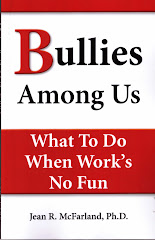
I’m delighted to announce that my new book, Bullies Among Us. What To Do When Work’s No Fun, is now available at Amazon Online and Barnes & Noble bookstores!
Here’s what one reader says:
” Jean McFarland’s Bullies Among Us needs to be put ahead of pivotal business books like Winning and Built to Last -– for the simple reason that winning cultures and sustainable growth cannot be fostered without first addressing bullying. Put another way, identifying and throwing out the Bad Apples is job one.”--Tricia Hamrin, UpFront Productions
Bullies, the worst of the Bad Apples, abound in workplaces all around the world. Look around you. Two out of every five Americans have experienced bullying at work. As though bullies don’t cause enough devastation through tormenting their targets, they also cost businesses billions of dollars each year in obvious and hidden costs.
Bullies Among Us tells you as a manager or as a target how to deal with the bullies in your workplace: Job One!
Here’s what one reader says:
” Jean McFarland’s Bullies Among Us needs to be put ahead of pivotal business books like Winning and Built to Last -– for the simple reason that winning cultures and sustainable growth cannot be fostered without first addressing bullying. Put another way, identifying and throwing out the Bad Apples is job one.”--Tricia Hamrin, UpFront Productions
Bullies, the worst of the Bad Apples, abound in workplaces all around the world. Look around you. Two out of every five Americans have experienced bullying at work. As though bullies don’t cause enough devastation through tormenting their targets, they also cost businesses billions of dollars each year in obvious and hidden costs.
Bullies Among Us tells you as a manager or as a target how to deal with the bullies in your workplace: Job One!
Saturday, August 30, 2008
Bullies and Nice Don’t Mix
Now, be nice! After all, you don’t want to burn any bridges behind you!
How many times in childhood did you hear the statement, “Now, be nice”? As an adult, how many times have you heard or thought, “Don’t burn your bridges behind you” —another way of saying, “Be Nice”?
Generally, when people are nice, they are treated nicely in return, but that’s not the case when you are the target of a bully. In my personal and professional experience, behaving nicely, pleasantly, or kindly to your bully simply elicits more bullying behavior directly aimed at you, the target. Bullies can view your pleasantries and niceness as yet another way that you surpass or threaten them, or they may see your behavior as a weakness. Regardless, your behavior fuels their desire to be rid of you.
Remember, bullies and psychopaths rarely think and respond as their targets would. More likely than not, reasoning won’t work and niceness will aggravate the situation.
How many times in childhood did you hear the statement, “Now, be nice”? As an adult, how many times have you heard or thought, “Don’t burn your bridges behind you” —another way of saying, “Be Nice”?
Generally, when people are nice, they are treated nicely in return, but that’s not the case when you are the target of a bully. In my personal and professional experience, behaving nicely, pleasantly, or kindly to your bully simply elicits more bullying behavior directly aimed at you, the target. Bullies can view your pleasantries and niceness as yet another way that you surpass or threaten them, or they may see your behavior as a weakness. Regardless, your behavior fuels their desire to be rid of you.
Remember, bullies and psychopaths rarely think and respond as their targets would. More likely than not, reasoning won’t work and niceness will aggravate the situation.
Subscribe to:
Posts (Atom)